Author
Prof. Dr. Salma Naz, Professor, School of Political Science, Minhaj University, Lahore, Punjab, Pakistan.
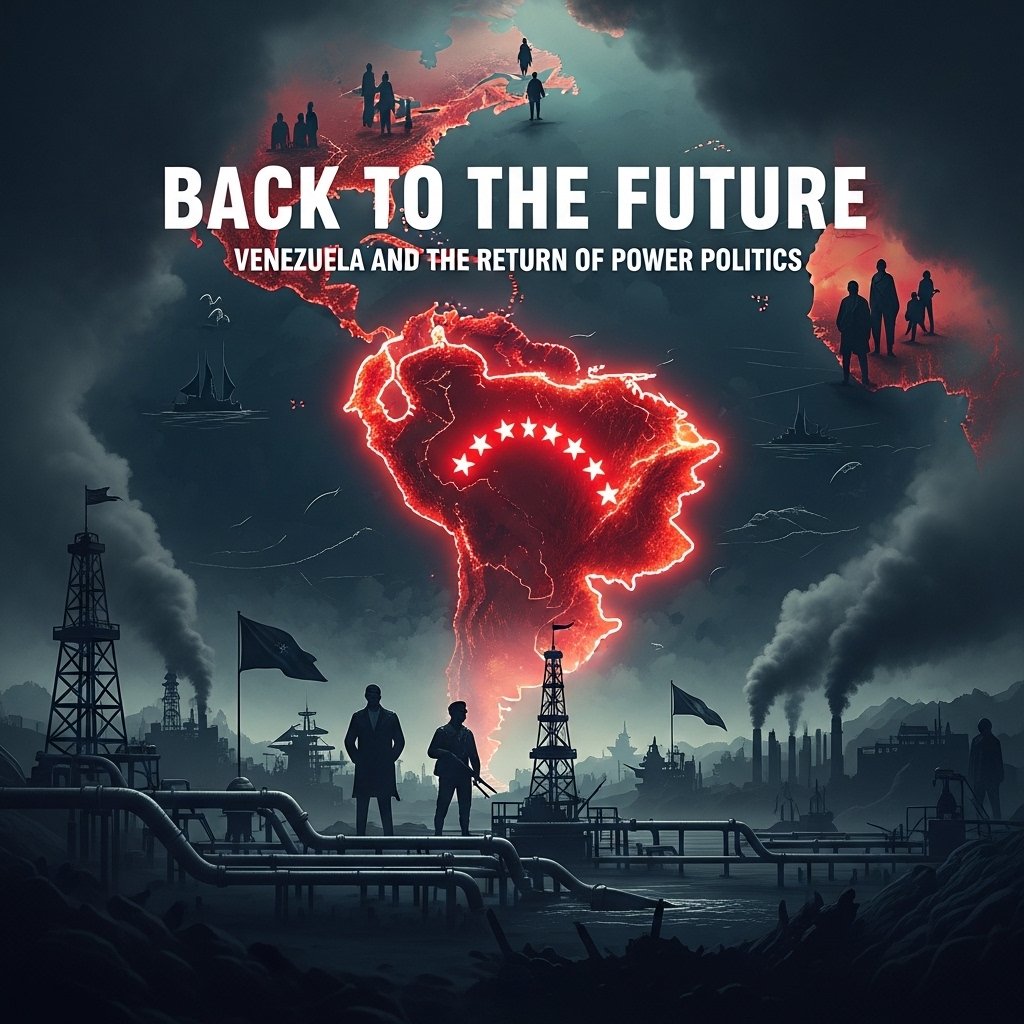
Contemporary world politics progressively echoes a past and less stable era. When big powers vied for influence, depend on the use of pressure rather than persuasion, and divided the world into regions of competing spheres of control. Current U.S. actions toward Venezuela suggest that world politics may not be advancing toward collaboration but reverting to an older, more hazardous pattern, in which strategic interests, military force, and spheres of influence overshadow international law, multilateral restraint, and sovereign parity. During the post-World War II era, global politics was enclosed as a rules-based world order. Instead of its faults and discrepancies, this system was based on the belief that the sovereignty of the state is sacrosanct and that the use of power must be restricted, collectively exercised, and grounded in international law.
The Venezuelan crisis reflects that this agreement is fading. In its place, a stricter reality is emergent. The key position of Venezuela in contemporary geopolitics rests on its material and strategic importance. Having the world’s largest verified oil reserves and occupying a strategic gateway to main Caribbean and Atlantic sea routes, the country holds a place having a strong similarity to resource-rich regions of imperial rivalry before 1914, for example colonial race for the Congo in Africa, the competition over oil-rich Persia, the British–French contest in Egypt, and the Anglo-Russian rivalry in Central Asia. Then, oil and coal were vital to industrial and armed supremacy. Nowadays, energy remains a pivotal tool of power. States reliant on consistent energy supplies inevitably view resource-rich but politically Unstable states as strategic prizes. Continued economic downfall of Venezuela, institutional destruction, and political polarization have only exposed it more to external forces.
History provides a sobering similarity, pré First World War period, poor governance paired with strategic relevance commonly led to external intervention, vindicated through security apprehensions or ethical discourse. Another important characteristic of the pre–First World War system was also marked by the absence of effective global governance and weak International institutions, and unilateral action was the global norm. The Hague Conferences of 1899 and 1907 failed to restrict great-power behavior, just as current global institutions fight to coerce unilateral sanctions governments. In the Venezuelan example, multilateral bodies have exercised limited influence in reinforcing the perception that global norms are inferior to the national interests of states. The current situation also depicts pre-1914 alliance dynamics. Prior to the First World War, big powers struggled for influence in zones of rivalry. For example, the Balkans have converted local clashes into global conflicts.
As before 1914, competing arrangements toughen, suspicion develops, and space for conciliation narrows. Great powers have often selected force over negotiation, confiding that their power would protect them from forfeits. In the case of Venezuela, American. Actions have mostly sidestepped genuine multilateral arrangements, making the sense that power not shared rules has become the source of legitimacy again. This crisis also mirrors the dangerous rivalries pre 1914, when strategic regions like the Balkans became testing grounds for rival empires to test one another force, eventually subverting the whole international system. Nowadays, Venezuela has developed a similar flashpoint, pulling in Russia, China, and Iran in response to U.S. pressure. As alliances once toughened on the eve of the First World War, today’s positions around Venezuela gesture an extremely divided and increasingly polarized global order.
At the core of the Venezuelan exists a pivotal inquiry that has designed international relations for centuries: “To what extent does Westphalian sovereignty remain a feasible principle when it conflicts with the strategic requirements of global superpowers? “Modern international law, mainly after the devastation of the two World Wars, was based on the principle of sovereign equality of states. Article 2(4) of the United Nations Charter clearly forbids the use of power against the Territorial autonomy or Geopolitical cohesion of any state, except in situations of self-defense or when sanctioned by the UN Security Council. This legal order was intended to inter the pre-1914 model where power, not law, dictated consequences. Up till now, the occurrences surrounding Venezuela propose a troubling reverse. Armed interference acceptable through unilateral explanations of security, criminal justice, or moral requirement resonances the before First World War era, when legal restraints were weak, and sovereignty was conditional upon power.
International order experiencing severe outcomes, many states included in the Global South are rich in resources but have structural weaknesses. If sovereignty is defined as conditional right, as in pre-world war I era, no such state can maintain its territorial sovereignty. The decline of multilateralism deteriorates crisis-management structures. In pre1914 era absence of strong institutions envisioned that diplomacy would be unsuccessful under pressure. Currently, sidelined United nations organizations put at risk filling that gap , forcing countries to depend on autonomous actions and alliance politics . Moreover, bigoted adherence to norms undermined legitimacy.
When international rules are executed conflictingly, international law loses its preventive power. This recalls the pre-1914 era, where norms existed but recurrently were superseded by states, particularly big powers, to save their strategic interests. Conceivably, the most disturbing resemblance lies in strategic miscalculation. Major powers in pre- 14 be convinced that restricted pressure and coalition gesturing would discourage escalation. Rather than these actions forming a chain response culminating in world war. Whereas Venezuela is dubious to activate such a disaster, the wider regulation of coercive diplomacy upsurges systemic unpredictability in an already fragmented global order.
We have learnt from history that power politics is the prerequisite of global politics, but if there is no system exist to check it overthrows the system itself. The disaster of the global order existed in the pre–First World War was not abrupt and unexpected; instead, it was the cumulative consequence of repeated terrorization, miscalculation and institutional failure. By revisiting the past, international politics threatens to recreate similar situations that once resulted in ruin. Venezuela crisis may not activate a world war, but it indicates a wider transformation toward a global order identified by pressure instead of partnership. If this pattern persists, the world may again find itself imprisoned in an unstable system one where conflict becomes not unavoidable, but increasingly possible