Ali Ahmad Faruqi : Undergraduate student, Department of International Relations, International Islamic University,
Islamabad, Pakistan
Abstract
In April,2026 Pakistan mediated a temporary ceasefire between US/Israel and Iran. This is a Diplomatic
achievement however; the fundamental issues are still unresolved. Therefore, it can be viewed as a
temporary break.
Islamabad as the Hub for Regional Peace
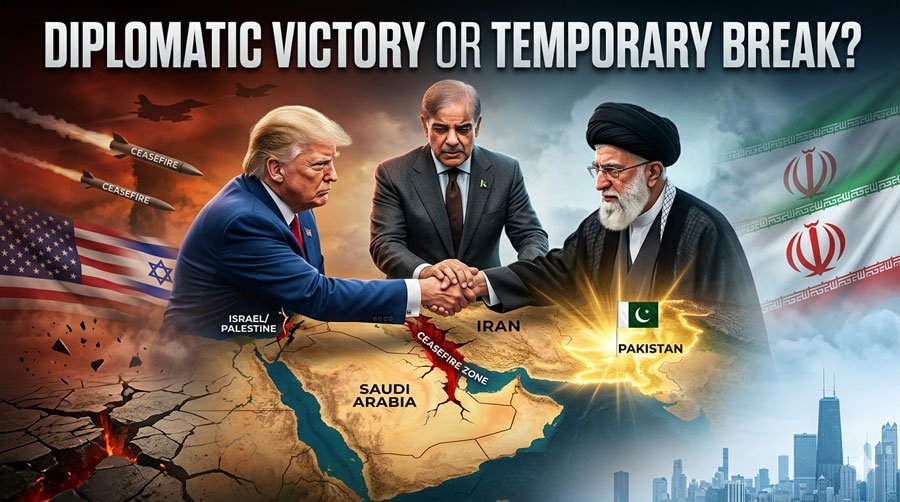
On 7th-8th April 2026, Pakistan mediated a two-week ceasefire between the US/Israel and Iran, managing to halt the war and providing the world with a sigh of relief. PM Shahbaz Sharif and Field Marshall Asim Munir convinced the warring parties to negotiate peace through table talks, beginning on April 10. Islamabad is hosting the US and Iran to reach a peaceful conclusion to the war. This could be perceived as a major diplomatic victory for Pakistan, but in reality, this ceasefire is only a temporary break. On 28th February 2026, the US and Israel launched combined attacks on Iran under the systematic plan of Operation Epic Fury. In retaliation to the continuous attacks, Iran shut down navigation in the Strait of Hormuz, a maritime trade passage, responsible for 20 percent of global oil trade. The Strait’s closure caused huge fluctuation in oil prices in the international market which subsequently led to the massive rise in Pakistan’s oil prices, which became an imminent threat to the country’s economy. The ceasefire has been brokered, but the major issues, such as Iran’s nuclear development, the control of the Hormuz Strait, Israeli strikes in Lebanon and Iran’s 10-point plan have still not been resolved. So, the lasting peace is still very difficult to implement.
The Fragile Nature of the Truce
The war continued for 40 days. The US carried out loads of attacks on the Iranian military and leadership, particularly killing Iran’s supreme leader Ayatollah Khamenei and its de facto leader Ali Larijani. According to the reports of Human Rights Activists News Agency (HRANA), nearly 3600 people have been killed in Iran so far. The disruption of trade through the Strait of Hormuz led to a fuel shortage globally. Pakistan’s efforts through its back-channel diplomacy led to the success of two-week ceasefire between the US/Israel and Iran. As a result of this success Iran promised to reopen the Strait of Hormuz and the US and Israel suspended their attacks on Iran for two weeks. However, this agreement looks fragile as Israel continues to attack Lebanon, as it claims that the suspension of attacks on Lebanon is not a part of a ceasefire. According to Al Jazeera reports, Israel launched enormous attacks on Beirut against Iran-aligned Hezbollah militia, killing more than 250 people, hours after the truce was announced in the US-Israel war on Iran. Similarly, The National News UAE and Al Jazeera reports claim that the UAE is actively engaged in dealing with Iranian ballistic missiles and drones. Reports suggest that the UAE armed forces dealt with 17 ballistic missiles hours after the US/Israel-Iran truce was announced.
Pakistan acted as a bridge between the warring parties and analysts believe it could be seen as Pakistan’s diplomatic victory. According to Al Jazeera, the Iranian Foreign Minister thanked Pakistan for its efforts in mediating the ceasefire. President Trump himself appreciated Pakistan’s efforts in brokering the ceasefire and called it a big day for world peace. Pakistan has proved its key role in regional conflicts and it is a major diplomatic effort which enhanced the importance of Pakistan in the region and worldwide. But the core disagreements, such as Iran’s uranium enrichment, US military bases in the Middle East, Strait of Hormuz still exist and the ceasefire is unable to halt the Israel-Hezbollah fight. Iran claims that a ceasefire has been agreed for the whole region and according to Reuters, Iran says that it would be unreasonable to start peace negotiations if Israel continues its strikes in the region. This distinction depicts that the ceasefire is fragile and the war could start again. History teaches that such short-term ceasefire often fails if the core issues are not resolved. The most recent example is the Israel-Hezbollah ceasefire in 2024. According to UNIFIL reports, from November 2024 to February 2026, 10,000+ Israeli violations of the ceasefire were recorded. The ceasefire was broken and the full-fledged war began in February 2026 during the US/Israel-Iran war. However, according to the latest New York Times report, the Israel-Lebanon talks have been planned in Washington on April 14 to halt the fighting which is a positive development for the regional peace. But if the negotiation fails, then it would be a serious blow to the ceasefire brokered between the US/Israel-Iran.
Evolution from Mediator to Architect of Peace
Another piece of evidence that defines the fragile nature of this ceasefire is that both parties declared victory. President Trump, in his Oval Office press conference on April 1st, claimed that the US has achieved its targets by killing the Iranian religious leader along with first-tier leadership. He also asserted that the US military strikes had obliterated the Iranian nuclear program and Iran would not be able to develop nuclear weapon for many years. On the other hand, Iran claims victory as the US agreed to negotiate upon Iran’s 10-point plan. Iranian Supreme National Security Council stated that the enemy has suffered an undeniable, historic and crushing defeat. In Islamabad talks, if the US rejects Iran’s 10-point plan, then war could resume. Therefore, the mediation effort to halt the war is Pakistan’s major diplomatic milestone. But considering it a victory at this stage would be premature.
To conclude, I believe that it’s a face-saving opportunity for the US as it failed to meet its objectives in Iran. The US targeted a regime change operation in Iran, but it failed to topple the religious Iranian regime despite killing the Iranian supreme leader. Moreover, the US failed to establish control over the Strait of Hormuz. As far as Pakistan is concerned, it should continue its diplomatic efforts to resolve the US/Israel-Iran conflict through peaceful negotiations. Now is the time Pakistan should transform its role from mediator to architect of a permanent peaceful settlement of the war. Pakistan should focus on resolving the core conflicts of the war otherwise, the war would be inevitable.
Reference
- Human Rights Activists News Agency. (2026, April 7). Nearly 3600 killed in US-Israeli strikes on Iran. Human Rights Activists in Iran. https://www.hra-iran.org/nearly-3600-killed-in-us-israeli-strikeson-iran/
- Al Jazeera. (2026, April 8). Hundreds of casualties across Lebanon after Israel says it hit 100 sites. https://www.aljazeera.com/news/2026/4/8/hundreds-of-casualties-across-lebanon-after-israelsays-it-hit-100-sites
- The National. (2026, April 8). UAE intercepts 17 ballistic missiles and 35 drones in Wednesday’s figures. https://www.thenationalnews.com/news/uae/2026/04/08/uae-intercepts-17-ballisticmissiles-and-35-drones-in-wednesdays-figures/
- Al Jazeera. (2026, April 8). UAE, Kuwait, Bahrain report attacks despite Iran-US ceasefire. https://www.aljazeera.com/news/2026/4/8/uae-kuwait-bahrain-report-attacks-despite-iran-usceasefire
- Al Jazeera. (2026, April 8). How Pakistan managed to get the US and Iran to a ceasefire. https://www.aljazeera.com/features/2026/4/8/how-pakistan-managed-to-get-the-us-and-iran-toa-ceasefire
- Reuters. (2026, April 8). Trump agrees two-week ceasefire; Iran says safe passage through Hormuz possible. https://www.reuters.com/world/asia-pacific/trump-agrees-two-week-ceasefire-iran-sayssafe-passage-through-hormuz-possible-2026-04-08/
- Middle East Monitor. (2025, November 21). UNIFIL reports over 10,000 Israeli violations in Lebanon since last year. https://www.middleeastmonitor.com/20251121-unifil-reports-over-10000-israeliviolations-in-lebanon-since-last-year/
- The New York Times. (2026, April 10). Israel and Lebanon plan talks in D.C. as war threatens cease-fire. https://www.nytimes.com/2026/04/10/world/middleeast/israel-lebanon-ceasefire-talks-iranwar.html