
Abstract
This essay examines the Middle East conflict through Graham Allison’s concept of the Thucydides Trap. It explores how fear of influence between established and rising powers can increase war risks. It also considers how regional diplomacy may reshape power transitions and promote long-term stability regionally.
Keywords
Thucydides Trap, Middle East, United States, Pakistan, Iran.
Recent Escalations and the Risk of Global Confrontation
On Wednesday 29th of July, the Middle East conflict expanded to new fronts when the Egyptian port of Damietta was reportedly hit by a drone. On the same day, United States and Saudi Arabia carried out joint strikes on Iraqi paramilitary groups backed by Iran. Prior to the events, the Ukrainian strike on Iranian cargo ship in the Caspian Sea already raising the eyebrows towards the risk of direct confrontation at a very large scale. The ongoing conflicts seem to drag many fronts including U.S., Middle East, Eastern Europe & Northern Asia (Russia) as well as China and South Asian region, if the U.S.- Iran conflict further escalates.
Keeping in view the current hostile situation across the regions, it is significant to understand the whole scenario through the prism of Graham Allison’s ‘Thucydides Trap.’ Allison is of the view that rivalry between ruling and rising power often creates strategic competition that can make war inevitable. He analyzed 16 different cases from history starting from Peloponnesian War in 431 BCE to U.S. and Russian Cold War Era (1947- 1991). Out of 16 cases, war was inevitable in 12 cases whereas successful management made it avoidable in 4 cases. Concluding Allison’s model, the emerging power starts demanding greater influence and recognition, the established or ruling states start fearing loss of strategic alliances and market control.
Shifting Power Dynamics: U.S. Hegemony and Regional Pluralism
In the recent day scenario, United States is no doubt an established power with all its economic giant and military might. The country has been enjoying competing theatres on the global front like managing global finances through World Bank and IMF or enjoying an extensive network of alliances in Indo- Pacific Region.
However, the current Middle East crisis and rise of regional powers like Iran, Israel, UAE, Qatar and Saudi Arabia have turned the regional game more pluralistic. All these regional middle powers have expanded their influence both militarily and diplomatically. Middle East has entered into a new realm of politics in which local powers seem more independent when it comes to their foreign policies. U.S. seems unable to dictate regional politics in the way it has done during the Cold War Era. Vali Nasr, a famous Iranian American political scientist and scholar of International Relations and Middle Eastern Politics is also of the view that U.S. disengagement after Iraq and Afghanistan Conflicts created a visible strategic space for other powers like China, Russia, Iran and other middle powers (Nasr, 2013). The rise of middle powers and disengagement further declined the influence of U.S. in the region. Steven Cook, a famous foreign policy analyst specializing in Middle East also argues the same. He maintains that U.S. political influence has weakened over time. Although military superiority of U.S. remains enormous and relevant but it is more about managing crisis than reshaping the structure (Cook, 2024).
Regional Rivalries: The Israel-Iran Power Transition
So, keeping in view the declining influence of U.S. in regional politics and rise of regional middle powers, Thucydides Trap can be used as an analytical framework to explain how regional power transitions and structural changes may lead to a trap that can make war inevitable at regional as well as global level. It may become a dangerous structural rivalry in the days coming ahead.
It is important to note that Middle East contains multiple overlapping traps/ power transitions. Current Israel- Iran Rivalry is the closest application of Allison’s Model. Israel is continuously trying to preserve its superiority both technologically as well as militarily including advanced jets, precision strikes, missile defense system like iron dome and advanced intelligence and cyber warfare systems. In this regard, Israel is enjoying close strategic partnership with the U.S. On the other hand, when it comes to Iran, the country is expanding its regional influence through state as well as non- state actors including drone technology, proxy networks and partnerships with powers like China and Russia. The close alignment of regional powers with the superpowers clearly indicates the future alteration of regional balance of power and a struggle for hegemony at global level.
Superpower Competition: Economic Statecraft and Security Alliances
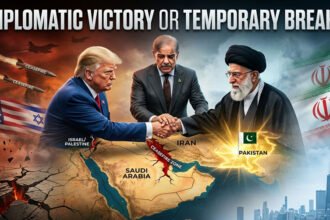
Furthermore, according to Thucydides Trap, the mutual suspicion between rising and established power creates an environment for preemptive measures that can be seen time to time in the case understudied i.e. U.S.- Iran Conflict via military actions, strikes, proxy wars and covert operations. Regional struggle for influence and developing alliances may act as a catalyst in the great powers’ game. United States has proved to be a dominant actor in the region since long through its military support and economic aids. On the other hand, China is continuously expanding its influence via investments, technology, alliances and through the vision of ‘competitive coexistence.’ BRI and other energy projects with the Gulf countries are some clear examples. Without any direct military confrontation, China is endlessly growing its influence through economic statecraft anchored by its ties with Saudi Arabia, Iran and GCC countries. The influence is creating a strategic competition without direct military confrontation. However, there are structural limits of China that bound its diplomatic leverages in the intense crisis of Middle East. Although China’s economic influence is far reaching yet it is not enough to replace U.S. influence when it comes to security including intelligence sharing, advanced weapons and technology. Though the U.S. security cooperation is deep rooted in Middle East, many scholars argue that United States is no longer exercising undisputed influence in the region. U.S. is continuously encouraging regional diplomacy. For example, the role of Pakistan as a mediator for neutral diplomacy is the best example of strategic hedging. It seems that when dominant power becomes less engaged in diplomatic affairs, regional powers become more engaged to shape regional order. This shows the emphasis of Allison’s model on power transition. According to Allison, war was often the result of structural changes like the rise of a challenger and fear of loss in ruling power. And this structural change is the outcome of military power, alliances and arms race.
Strategic Hedging: A Mid-Course Framework for Pakistan
As far as Pakistan is concerned, it is situated at the intersection of South Asia, the Gulf, and China’s Belt and Road Initiative (BRI). Applying Allison’s Thucydides Trap alongside balance-of-power theories, it is important to note that Islamabad needs to adopt hedging as a foreign policy strategy in this great power competition instead of developing bilateral relations, only. To overcome the probability of Thucydides Trap, ‘competitive coexistence’ could be the best possible mid course framework. All the actors need to prevent crisis through diplomatic mechanism while competing where interests collide and cooperating where interests intersect.
Conclusion: Evolving Geopolitics and Modern Constraints
The evolving geopolitical directions identify that China is expanding economic influence. Russia is also strengthening its military engagement. In this equation, Gulf States are also building new strategic partnerships. While U.S. remains crucial but is no longer the sole power when it comes to regional politics. Washington seems to reduce costly engagements, however trying to maintain presence in order to prevent emergence of any regional hegemon.
Last but not the least; many scholars criticize Allison’s model as according to them cases from history are totally not comparable to modern nuclear age. Nuclear capabilities turn war riskier and more costly. Moreover, the deterrent value and economic interdependence also matter. In Great Power Game, U.S. and China are deeply connected through trade networks. Institutions also matter like WTO, G20 and UN provide channels for bargaining that did not exist historically. So, if United States and Iran put an emphasis on successful management regarding regional matters, they would join the small group presented via Allison’s model where war was avoided.
References
Nasr, V. (2013). The Dispensable Nation: American Foreign Policy in Retreat. New York. Doubleday.
Cook, S. (2024). The End of Ambition: America’s Past, Present, and Future in the Middle East. New York.
Oxford University Press